Showing posts with label purpose. Show all posts

Thursday, September 16, 2010

Reality Check Inventions

The Students have designed some inventions and spoken about the on ustream.
I was impressed by the creativity that went into ideas such as the “ultimate hair brush”,
”The Magniball wall” and the “Super Alpaca feeding station”. The ability to adapt, change and think in different ways shows that young students are able to move from designing to inventing. Well done.

It takes bit of strength to get up in front of the camera. There is a pause for about 30 seconds while one student gets up the courage to show what they invented.


Thursday, July 22, 2010

digital citizen ideas from Derek Wenmoth


Wednesday, July 21, 2010

Reality Check -Inventions

After a long time of being busy helping setting up a new professional learning community I finally had a chance to work with students again. So what Am I trying to concentrate on.

  • lots of opportunity for students to contribute, think, do and to create flow
  • using visual material and offering some choice for students to select material
  • reflection on what we have created and opportunities for students to outline where their learning is at
  • looking at habits of mind as prompts for just in time learning opportunities “what habit of mind do you think could have helped you get past this point?” “taking responsible risks”
  • letting student thinking and communication exist in its own right ie not all thinking needs to be reported on or commented on it can just “be”.
  • integrating literacy work into just in time teaching moments with questions like “If this is going to be read by others what might we need to in terms of editing?”
  • Having student share reading and retelling of others oral and written ideas


The investigation prompts and some outcomes are below


image


We are going to look at a couple of movies to find out.


Here are a few more links to inventions, and kid inventions; have a look.

image 

This is what 4km thought what  they did was to use typewith.me to describe everything they thought about where inventions come from and then we put them into this Wordle This is what we thought.

image

Where do Inventions come from? from Media team on Vimeo.

What we think about inventions and where they come from.


Sunday, May 16, 2010

Motivation

Daniel Pink talks about motivational aspects in his book Drive

Motivation requires three aspects

  • Real sense of purpose
  • Sense of Autonomy
  • Sense of potential Mastery in what they are attempting

It concerns me that sometimes we seem to focus on things we think they should know rather than what motivates them.
Dan’s talk on the subject has a lot to offer educators looking for improved student outcomes.

At the school where I work I heard some students who were working on a market day project the other day say to a teacher "I have never worked so hard before". The way the student said it was with immense pride. The project has obviously struck a chord and motivated students to learn and achieve.


Wednesday, December 30, 2009

Letting kids learn

“The longer you wait for the future, the shorter it will be”

ThinkExist.com Quotations. “Loesje quotes”. ThinkExist.com Quotations Online 1 Nov. 2009. 28 Dec. 2009 <http://einstein/quotes/loesje/>

I had the opportunity to work with some students who were taking part in end of year examinations. Those who finished early (and in this case most did) were given the opportunity to do something quietly. I watched as they involved themselves in a number independent activities. I took some photos on my mobile which are here in the slideshow. I reminded me of books we used to have like 100 things to make and do. I feel that this sort of activity, scaffolded and enhanced, has the ability to increase the potential of our student’s

literacy/numeracy/operacy .

Have a look at the slideshow (just eight pictures) and I will explain what I mean.

The only instruction given was that the activity had to be silent while others were working on their exams. We have looked at and developed a framework for learning at Southwell where I teach. I highlighted the values and key competencies personal learning time similar to this might support. This is about “learning to learn” and putting the learner at the center of the learning. Accepting where our students are at and providing them with the tools for self improvement but how ….

image

Quality Assurance
Such a strategy as this independent learning time is now possible to develop and support through the use of ICT tools. I believe the key characteristics of this might be. This is the big disclaimer

  • Classroom Climate - Supportive classroom communities where learning modeled shared celebrated etc.
  • Reflection/expression/evidence/collaboration portals ie social networks, eportfolios (for lack of better word), gallery spaces, video repositories etc
  • Clear goal setting and articulation for learning perhaps SMART Students are asked to check off whether the goal is specific, measurable, action-oriented, reasonable and timely. This could be as simple as What is the purpose of this learning? What will represent success for me? What have I/we done so far? What do I/we plan to do next? with this information in a web environment peers and others can be used to motivate guide learners through this.
  • Formative community assessment – embedded teacher,peer and whole class feedback/feedforward
  • Time availability for learning to take place – this could be small pockets of time after say maths in an primary/elementary environment as we know that the brain need less intensive work in order for the neural pathways to become entrenched see syn-aps. It could also be represented in a more flexible programme where teachers facilitate learning with significant online support and individual access to personal learning.
  • Exemplars, evidence – Examples of tall poppies – growing poppies and aspiring poppies give students a clear direction.
  • 1 to 1 Access - to the connectivity, networks, creation tools and appropriate physical spaces and resources.

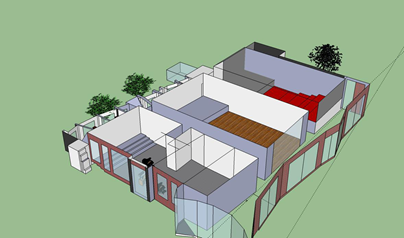
The place of personal learning can find its feet and show its evidence. I will finish with a building created in google sketch up by a year 7 students and a link to an online novel written by my son Jack (16) both examples of personal learning and endeavour.

pac2

image

image


Saturday, October 17, 2009

What Kids Are Doing - check 1 -

Kids are sophisticated media producers....

if we let them
if we let them share with each other
if we give them an audience

How do we lift their level even higher?


Sunday, July 26, 2009

The Dog Woke Me, The Blog called Me

It’s 2.59 and the dog has come around to the front of the house and woken me. There have been a lot of thoughts in my head about blogging its relationship to learning and now am in front of the computer putting them down.


A New Zealand teacher posted some pictures of students running a cross country. The purpose of this was for parents to be able to see their children and the children to see themselves online. What followed was a series of opinions criticising the use images and names and implying the teacher should not be blogging because of lack of understanding of net safety and protocol. What a post on whaleoil's blog shows in my mind the need to prepare for comment or controversy where we least expect it.

Can we just grow up in public?

We engage in blogging to change our personal or community worlds. A post is out in the global domain may  be seen as a statement even if we don’t intend it to be. A process is taking place where we are often adjusting our thinking, forming opinions and learning.

  • What happens if we don’t follow protocol?
  • We say something that our schools for example don’t believe in?
  • What happens if we make a mistake?, Have a bad moment?
  • What happens if someone takes issue with what we have to say?
  • What are the risks if we are blogging at school as a classroom community?

Firstly I do not believe the greatest risks are from Stalkers or paedophiles as some would have us think. A photo and a student’s first name is a responsible risk. In New Zealand the ministry of education guidelines for inclusion of images is here. With parents permission there is no issue here.  The teacher posted some pictures of students running a cross country. The purpose of this was for parents to be able to see their children.The greatest risk I see with blogging are pedants and nitpickers.

image

To help survive this risk

  • find out about blogging from an experienced leader, doer and thinker such as Dorothy Burt
  • try to make sure our words make sense (not always a strong point of mine)
  • read other class blogs and online material
  • realise that our audience may not be who we think they are
  • care mostly about our preferred audience (the one we want to engage)
  • develop a thick skin i.e. accept that we may fail at first but that is not a bad thing
  • moderate comments if it is a class blog or students
  • think about the content of other online presences we may have and how they are linked eg facebook

Also realise the benefits of blogging

We can see blogging changing peoples personal worlds and creating


 image

Blogging should be innately positive because it is based on choice

With so many people choosing to express themselves there seems a good match to

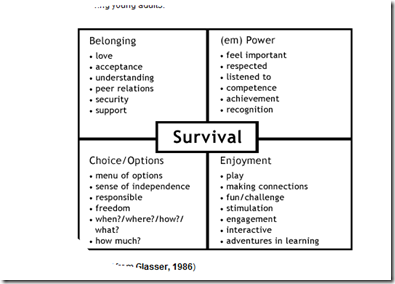
William Glassers model of Survival. Are we blogging for Survival? I have used this model

a few times and acknowledge Joan Dalton and David Anderson who introduced me to it.
image

So keep up the blogging or start if you wish to.

For Me I am looking to Work out what it means for our school as a community this term.

There are some more thoughts here in a guide to educational blogging from Microsoft.

And a more comprehensive reflection http://learningweb2.wikispaces.com/Important+considerations


Sunday, July 19, 2009

Seeing is Believing

Sometimes somethings just are!
When we worked as a team investigating the use of games in education one of our
goals was.

To determine the best method of student involvement in the game that will maximise student learning .

We posed this question to teachers and students as well as videoing what happened when we got 100 students together for a big game day. The video is below What do you think?


Sunday, April 26, 2009

Increasing intelligence

I have always been interested the idea of developing the gifted and wondered why we aren't all inventing creating and displaying understanding at a high level. I was optimistic that we were becoming smarter and smarter as inhabitants of the blue planet. A visit to the Waikato Museum made me reflect on this. The Da Vinci exhibition here in Hamilton showed this man who lived over 500 years ago and did so much for us, so much thinking and doing in one lifetime. While this man was an exception it would be good to think that we could all be capable of more. In a conversation with Mark Treadwell I remember him saying "the world is running out of smart people." We certainly have some challenges ahead of us and will need to maximise our smart people. Is this just a case of genetics? Royce Helm the headmaster of my school talks of "Intelligence is like a balloon which can be increased". Can we provide the conditions for increasing intelligence and still keep the benchmarkers happy? I think the answer is yes. The assessment process for basic literacy numeracy skills needs to provide information naturally so that we can take care of the basics with out spending huge effort to work out what these are. I share Suzie's dislike for league tables found in the linked post. If we are to increase our intelligence balloons education has to step up to the plate and take responsible risks some of these of the top of my head are

any webspiration user who want to collaborate in this diagram can email me and I will add them as authors.

On a final note in my mind we are definitely going to need help foster creativity to help us. Here is a reflection from a team of teachers at school as to what may effect the fostering of creativity

creativity


Monday, November 10, 2008

Five minutes on economic impact

This is intended to be a five minute post on one to one computing and price point.
While not the only issue things have to be affordable for parents and schools.
The price of the same Acer Aspire one netbook as gone up 20 percent in the past month.
Ouch !!!
So the contenders are

  • The classmate pc
  • The acer Aspire one
  • The eeepc approx
Not sure if they have all gone up but:
What we would need to see is: offsetting this against other costs such as stationary
but also an improvement in student learning.
This is notoriously hard to measure.

Here is hoping the parent jury value and believe that a good teacher will see
students learning to learn and showing exciting outcomes and understandings
from a 1 to 1 experience.


By the way the classmate is my favorite because of the price/performance

And oops took 10 mins of time for post looks like price of time has also gone up


Sunday, November 2, 2008

What matters matters

The things changing in education should be carefully considered.
If you read/view any post on this blog make it this one.

  • Why change?
  • What is the purpose?
Two years ago our school moved a learning plan system that included
student voice and presence at parent interviews.

It made the learner central to this. At the time we had student interview some teachers and students who had been through the process.
  • It was change!
  • It had purpose!
  • It worked!
The above clip shows a teacher who carefully considers why he does things.
With the introduction of the learning plan he considered what would take the learner further.
He considered the purpose for the learner and what might effect them in the process.

I feel we need to this more. Engage learners and give them purpose and it will work too.